Tag: racism
Call for Papers | “Race, Racism, and Anti-Racism in and through Sport Management Research”, Special Issue of the Journal of Sport Management | Call ends September 30, 2026

Contributions to this Special Issue will help further define and establish relevant theory and analytic frameworks that guide the explicit acknowledgement and study of race, racism, and anti-racism within the field of sport management. Through the exploration of these concepts, we challenge authors who submit to the Special Issue to heed to Wendy Frisby’s call for more critical social science (CSS) organizational research in the field and consider theories on race, racism, and related critical paradigms/frameworks (e.g., critical race theory, CRT, and its various extensions).
Call for Proposals | Critical Research in Race and Sport, A New Book Series from Routledge
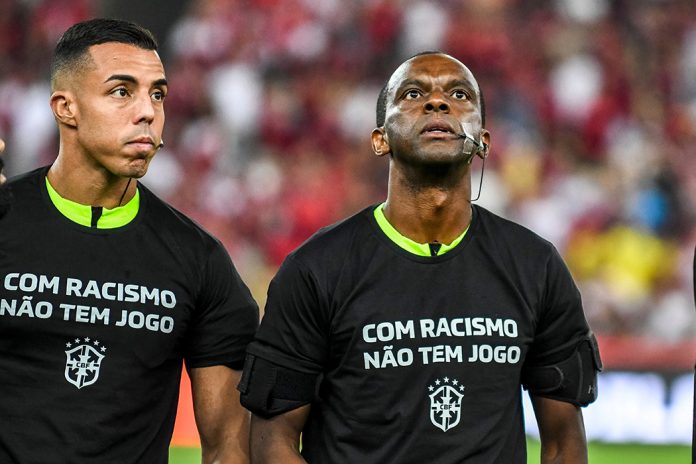
This new book series showcases critical scholarship on race and/or racisms in sport and welcomes contributions from emerging and established scholars from the Global South and Global North. It is multi-disciplinary in scope, platforming research from all disciplines including sport studies, business, and management; as well as work from sociology, literature, history, philosophy, geography, feminism, cultural studies, politics, media studies, leisure studies, disability studies, ethnic studies, and beyond.
Call for Participants | Jesús Costantino: “Friday Nights Live: Television and Prizefighting in the Post-Segregation Era” | Iowa Colloquium on Sport and Culture. Webinar on Zoom, Friday November 10,...

The relationship between postwar television broadcast and the Civil Rights Movement is complex. In an effort to untangle some of this fraught history, this talk examines the entanglements between live television broadcasts and interracial prizefighting in the 1950s and 1960s. Looking at the history of live prizefight broadcast as well as the TV and film versions of Rod Serling’s Requiem for a Heavyweight (produced in 1956 and 1962, respectively), the talk analyzes the ways live broadcast technology was shaped by (and shaped in turn) the post-segregation racial regime.
Call for Papers | ‘Cricket in a post-ICEC World: Where do we go from here?’ | CC4 Museum of Welsh Cricket, Sophia Gardens, Cardiff, February 23, 2024. Call ends...

The conference is being organised by the Cricket Research Network (see below for a statement of aims), which is chaired by Dr Raf Nicholson. The conference will serve as the launch of the network, and all conference attendees will be encouraged to sign up to network membership. More information about the network will be provided during the conference. We are seeking short (maximum 20-minute) research-based presentations from anyone who has original research into cricket which they would like to share.
Call for Papers | “The Representation of Race in Sports Journalism and Media”, the Sports Media Identity Network Event #3 | Sheffield Hallam University, June 30, 2023. Call ends...

For the Sports Media Identity Network’s third event, we are inviting presentations which interrogate the role that the sports media, in particular sports journalism, plays in the framing of race in sport. Although this one-day event, which will be held at Sheffield Hallam on June 30 2023, has a broad focus, we particularly welcome abstracts concerning themes of diversity, representation and collaboration.
Call for Papers | “A Critical Examination of Race and Antiracism in the Sport for Development Field: Reimagining and Recreating Spaces for True Racial Inclusion and Equity”, a Special...

This special issue seeks critical examinations of research, policy, and practice that highlight, describe, and challenge racism, racist practices, and racial hierarchies in the SfD field, and in doing so, move closer to improving experiences and outcomes for racial groups facing intersecting oppressions. Race and racism are conceptualized as socially constructed systems of oppression grounded in political and economic domination on the basis of phenotypical and cultural identities and backgrounds.
Call for Book Chapter Proposals | Social Justice and the Modern Athlete: Exploring the Role of Athlete Activism in Social Change. Call ends April 30, 2021

The overarching focus of the book is to explore the role athletes have played in raising awareness of and advancing social justice issues. Authors are asked to consider various aspects of athlete involvement and influence, using a wide range of theoretical perspectives. Please note that although the book will provide an early historical chapter as the foundation for exploring athlete activism, it focuses on the past 30 years (1990-present), reaching beyond the Civil Rights era.
Call for Papers | “The Current Status of Racism in Sport Psychology and Liberatory Practices for Dismantling Systemic Racism” | Special Issue of Journal of Applied Sport Psychology, Call...

There is considerable work to be done in sport and sport psychology to achieve racial equality across all sport sectors and for all members of sport. For example, substantial system-wide reform that addresses recruitment, hiring, retention, and promotion of racially and ethnically diverse candidates of color in senior sport leadership roles, and coach training and development models that emphasize racial and culturally aware approaches
Call for Papers | “From Grassroots to hyper commodification”. The Football Collective Annual Conference | Sheffield, November 28–29, 2019. Call ends September 6, 2019

Drawing on research undertaken by members of the Football Collective, the 2019 Annual Conference will look to scrutinise the business of football to find solutions that will benefit clubs, their players, their fans and their local communities. This year's conference will also explore both the commercial and human benefits football can bring to the general population.
Call for Papers | “Leisure Cultures and Glocal Challenges to National Populist Politics” | Special Issue of Leisure Studies. Call ends 31 January 2018

This special issue interrogates how institutional and informal realms of leisure-based protest, resistance, and counter-hegemonic struggle continue to operate in recognizable ways; and how emergent leisure-based cultures, practices, contexts and tactics are being developed that offer a rupture to normative regimes, discourses and practices.